Most people have traveled taking a plane at the airport and seen the control towers. The aim of this building is to manage the movement of all planes and vehicles on the track and in the entire air zone, to control and take decisions and monitor the air space around the airport. So, its objective is to have all information around it to have a proper visualization for people in it taking the right decisions at the right time.
We can define a Control Tower as a hub for visibility, decision-making, and action, based on real-time analytics centralizing all data coming from different systems from the shop floor and business layer.
This concept is applicable to the food processing sector as well.
Within food processing, there are a lot of different actions and interactions to consider. Traditionally. it has been a labor-intense sector, but today it is adding more automation to improve efficiency, quality, and labor conditions. In this sense, solutions and technologies more mature in other sectors are disrupting the way food processing is managed.
All systems, machines, but also people must be well synchronized and orchestrated in order to have a smart factory. For this purpose, it is important to have a Control Tower where all information is gathered to the same place. The Control Tower should then be ready to take fast decisions, generating the right insights pursuing continuous improvement of the process.
What to manage
One of the main functionalities is having all data available and providing the end-user actionable insights for the process. Questions they need to be self-answered with Control Tower:
- How long is Order to Cash?
- What is the yield of my business?
- How efficient is my process?
- How am I using my resources and assets?
Sometimes there is no answer to some of the previous questions or the answer is the combination of multiple Excels, exports from a system and another concept in someone’s mind. Therefore, it is important to have visibility to spread the same message to all stakeholders.
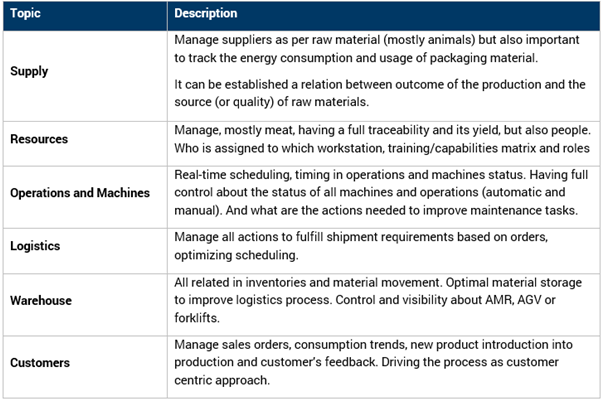
Topics needed to answer the questions:
What is the outcome
First and most important is having the visibility of the entire business and knowing what is happening on the first stage. That means that different systems are well integrated and that the end-user is not breaking his/her head to find the information, aggregate it, combine it and digest it.
From this stage on, business is getting more capabilities to generate more value out of the digitalization process, which is part of the Industry 4.0 roadmap (we will cover this topic in detail in another article).
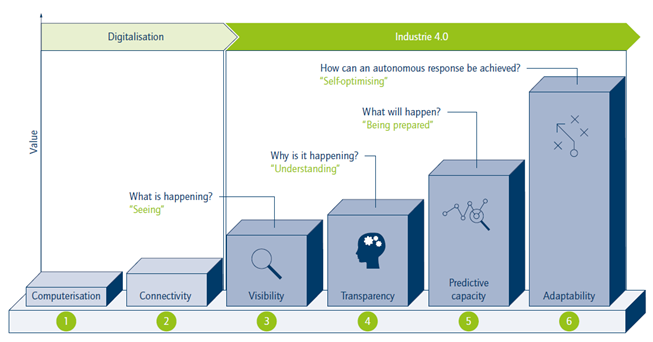
Figure 1: Stages in the Industry 4.0 development path (source: FIR e. V. at RWTH Aachen University)
The Control Tower does not just have a multi-monitor control room where all different systems are displayed within the same room. It goes beyond this. Providing real interaction with the end-user is helping them in taking the right decisions or having the feedback from the actions done. However, the very first phase must be to get a connection to all the things in the business (IoT principle).
Coming back to the main concept, the Control Tower is being used in other sectors and for other purposes than from managing airplanes. But it is following the same method: All information gathered at the right place and at the right time.
Because we all want to have an excellent user experience flying on time, with assets being well maintained, avoiding climate conditions as much as possible and, of course, with the highest level of security.
Author

Oriol Llargués
Manager
ola@frontmatec.com
+34675820857

 EN
EN
 English
 中文
中文
 Español
 Deutsch
 Français